
Going Through the Roof: What Four Friends Teach Us About Reaching People for Jesus (Part 1)
By Pastor Rick Warren
One of the most remarkable stories in the gospels is the account of the paralyzed man whose friends lowered him through a roof so he could meet Jesus.
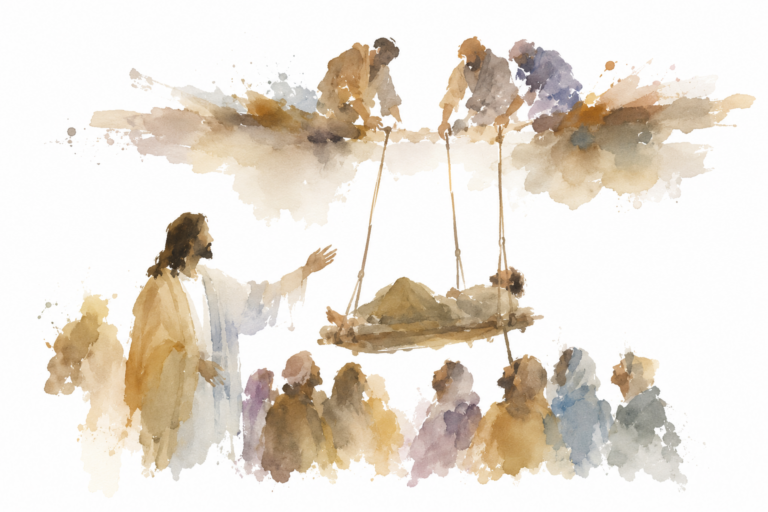
It’s told in three different gospels – Matthew 9, Mark 2, and Luke 5. You know when something is repeated in the Bible, God wants us to pay attention to it. Four ordinary men brought a hurting friend to Jesus. They couldn’t get through the crowd, so they climbed onto the roof, tore a hole in it, and lowered their friend down right in front of Jesus.
When Jesus saw what they had done, when he saw the faith of these friends, he healed the man and forgave his sins.
I love this story because it isn’t just about a miracle. It’s a picture of evangelism. It shows us what it looks like when ordinary believers work together to bring people to Jesus.
As I look at these four friends, I see seven lessons every believer and every church can learn about reaching people who don’t yet know Christ:
1. Become Concerned About the Lost
Everything starts with compassion. Before these men carried their friend, they cared about him.
Your mission in the world is worthless unless it’s motivated out of love. The Bible says that without love I am nothing, just “sounding brass or a tinkling cymbal” (1 Cor. 13:1 KJV). I say it often: people don’t care how much you know until they know how much you care.
Romans 15:2 says, “We should all be concerned about our neighbor, and the good things that will build up his faith” (GW). 1 Corinthians 10:24 echoes, “People should be concerned about others, and not just about themselves” (GW).
You know the number one reason why we don’t reach out to unbelievers? It’s not fear. It’s preoccupation.
We’re just too busy with our own lives, doing our own thing. We’re too busy having fun, going to Bible studies, attending church meetings. We don’t have time to get to know our neighbors or the people at the office. We can’t see the hurts around us.
I sometimes joke that Christians are a little like manure. You pile them all up in one place and eventually it starts stinking. But if you spread them around, they can do a lot of good. God never intended for believers to spend all their time around other believers. He wants us spread throughout our communities as salt and light.
Before you can fulfill your mission, you have to get a heart for the lost. God used these friends because they were sensitive to the needs of someone around them. They weren’t preoccupied with themselves.
If you care, you’ll be aware. When you care about people, you become aware of their needs. And when you’re aware of their needs, you’ll start praying for them.
One of the best things you can do right now is make a list of at least five people who don’t yet know Christ and begin praying for them regularly.
- Pray that God softens your heart toward them.
- Pray that God softens their heart toward Christ.
- Pray that God creates natural opportunities for conversations.
- Pray that God gives you a burden for people who are far from him.
The starting point of your mission is simple: identify people by name and begin praying for them.
Psalm 126:5 says, “Those who sow in tears will reap with songs of joy” (NIV). Let me ask you a very frank question: Have you ever been so concerned for the salvation of another person that you have wept while you prayed for them? We need to ask the Lord to let our hearts be broken with the things that break the heart of God.
I know all kinds of Christians who will go to movie after movie and weep through stories that aren’t even true, but have never shed a tear for a lost person. If you’ve never shed a tear for somebody that doesn’t know Christ, you need to do a heart checkup. Because the dearest thing to the heart of God is the death of his Son, Jesus Christ, and the second dearest thing to the heart of God is when His children share that message with those who don’t know it yet.
2. Believe That Jesus Can Save
Compassion alone isn’t enough. If we’re going to help people find Christ, we must also believe that God can change lives.
Luke tells us in chapter 5 verse 20, “When Jesus saw their faith, he said, ‘Friend, your sins are forgiven'” (NIV). Notice that distinction: Jesus acted on their faith.
The paralyzed man didn’t have enough faith to get himself to Jesus. His friends carried him.
Many people around us are spiritually paralyzed.
Some are paralyzed by fear, guilt, and shame. Others by a painful church experience, anger, resentment, or disappointment.
They need somebody who believes God can still change lives.
I’ve learned something over the years. When I expect God to work in someone’s life, he often does. When I expect people to respond to the Good News, they often do.
Perhaps one reason you haven’t led anyone to Christ is that you’ve never expected God to use you. You’ve lacked the faith to believe that God could work through an ordinary person like you.
But often that lack of faith isn’t just about God’s ability to use us. It’s also about his ability to save the people around us.
Have you ever had someone in your life who you thought was hopeless? Someone you quietly decided would never start a relationship with Jesus?
I would guess most people have someone like that. Maybe it’s an apathetic relative. A hostile parent. A sarcastic coworker. A son who has wandered from God. A spouse who shows no interest in faith. They seem so hard, so cold, so resistant that it feels like they will never come to Christ.
But no one is beyond the reach of God’s grace.
If you’ve thought, “Never in a million years will that person come to Christ,” you’re wrong. Jesus is able, now and always, to save those who come to God through him. The Bible says, “With God, all things are possible” (Matt. 19:26 NIV).
Never underestimate what God can do in a person’s life.
The moment you stop believing God can work through you—or in them—is often the moment you stop praying, inviting, and reaching out.
3. Don’t Just Pray for People, Bring Them to Jesus
Matthew 9:2 says, “They brought to Jesus a man who was paralyzed and lying on a mat” (NIV).
Notice that these friends didn’t just talk about helping their friend. They didn’t simply discuss his condition. They didn’t just add him to a prayer list and move on.
They carried him.
Eventually our compassion has to become action.
Many believers pray faithfully for lost friends and family members, and we should. Prayer is where evangelism begins. But prayer was never meant to be the finish line. At some point, we have to take a step toward the people we’re praying for.
These four men made a deliberate effort to get their friend into the presence of Jesus. That’s what evangelism is: helping people take one step closer to the Savior.
In one of his parables in Luke 14:23 Jesus described the master of the house as giving this instruction: “Go into the highways and hedges and compel them to come in, that my house may be full” (AMP).
Notice the phrase, “Go out.”
Some Christians hear the word evangelism and immediately think, “I’m not gifted in that.”
That’s okay. Not everybody is an evangelist, but everybody can be a bringer.
You may not feel comfortable preaching a sermon or explaining every answer to every spiritual question. But that’s not what’s required to help reach people. You can invite a friend to dinner. You can introduce a coworker to a Christian friend. You can bring someone to church. You can welcome a neighbor into your small group.
Colossians 4:5 says, “Be wise in the way you act with people who are not believers, making the most of every opportunity” (NCV).
Most people come to Christ because somebody cared enough to bring them one step closer to Jesus.
God has already placed people around you for a reason: the neighbor next door, the coworker in the next office, the person next to you in class, the parent sitting beside you at your child’s sporting event, or the friend you’ve known for years.
These relationships are not accidents. God has strategically placed people in your life that he wants you to love, pray for, and influence toward Christ.
4. Don’t Let Difficulty Discourage You
The moment you decide to bring people to Jesus, you’ll discover what these four friends discovered: obstacles.
When the friends in the story finally get to where Jesus is, they couldn’t even get in. The house was already filled, but they refused to be discouraged by the crowd or the building. They’re determined to bring this man to Jesus.
What discourages you from bringing people to Jesus?
Do you get discouraged when people reject your first invitation? You try to talk to them about Jesus once and they say, “No, I’m not interested.”
Discouragement tempts us to give up. All of us get discouraged from time to time in our attempts to reach family, friends, or people that we work with, but we cannot give up. It’s too important.
Galatians 6:9 says, “Let us not get tired of doing what is right. For after a while we will reap a harvest of blessing if we don’t get discouraged and give up” (TLB).
When you’re discouraged, it’s helpful to remember that God was patient with you. The Bible says, “God is patient, because he wants everyone to turn from sin and no one to be lost” (2 Peter 3:9 CEV).
There was a man in our church who was prayed for by his small group for two solid years before he came to Christ. What if his group had given up praying after year one? I’m sure he’s glad they kept praying!
One practical way to remind yourself that people need the Lord is to set an empty chair in your small group as the symbol your group is always reaching out. Every week when you pray, pray for the person who should be filling that empty chair.
These first four lessons remind us that reaching people begins long before someone says yes to Jesus. It starts with compassion. It grows through faith. It takes intentional action. And it requires persistence.
In Part 2, we’ll look at three more lessons from these four friends—including why creativity, cooperation, and sacrifice are essential if we’re going to help people find Christ.